Where to start….

It’s been 2 months since I last blogged – and there are several reasons for this, but the main one was that I didn’t know where to start. The expected SEND white paper was delayed, the UK government want to introduce more testing, the US government claimed that Tylenol/paracetamol taken in pregnancy could cause autism, the IFS green budget had some very ‘interesting’ opinions on how to solve the SEND crisis, some Reform party members & councillors were criticising the SEND budget (but a local council has also spent £75,000 on union flags to be hung around the county), and then, more recently, there were bits in the autumn budget that makes me very worried about SEND funding, and finally, Wes Streeting, the Health Secretary has started a review into ADHD and ASD because they might be overdiagnosed, which then lead to a BBC GP survey where, apparently, many of them have said that ‘life being stressful is not an illness’ (link here) and that mental health conditions are being over diagnosed. Just when I thought, right, I’ve enough to blog about, something else pops up on my news feed and I then spend several days ranting at anyone who’ll listen, and I don’t actually start blogging.

This is obviously more than one blog, so today I’ll start with ASD, ADHD, diagnosis and causes. I wrote about the genetic roots of ASD & ADHD (link here if you want to read it). While there are some arguments that early life trauma can cause or trigger neurodivergent conditions, this could be an epigenetic trigger, where there is the genetic coding for a condition, but it can also be that trauma almost ‘switches on’ the genes and then the condition is more noticeable. However, sometimes trauma does not switch on genes, but instead, the impact on the body is so great that the external characteristics appear like ASD, ADHD, or PDA, but are a reaction to the trauma. In addition, some conditions, such as MS, can impact cognition in a similar way to dyslexia, but that doesn’t mean that MS causes or triggers dyslexia.

We are not in the middle of a neurodivergent epidemic. I didn’t suddenly catch ADHD in the last few years – the signs have been there since I was tiny, but ADHD was barely recognised in the 1980’s, and even less so in girls, so I was missed. I was also academic, got things done (often at the last minute). Nobody seemed that surprised when my GCSE and then A-level results weren’t near my predicted grades as I was always daydreaming, but if I were a child now, plucking feather duvets, not getting school work done on time, not concentrating in class, being messy, always forgetting where I put things, having a large gap between my reading and spoken language and my written language, the school, or my parents, may have flagged this. I may have had an assessment much, much younger.

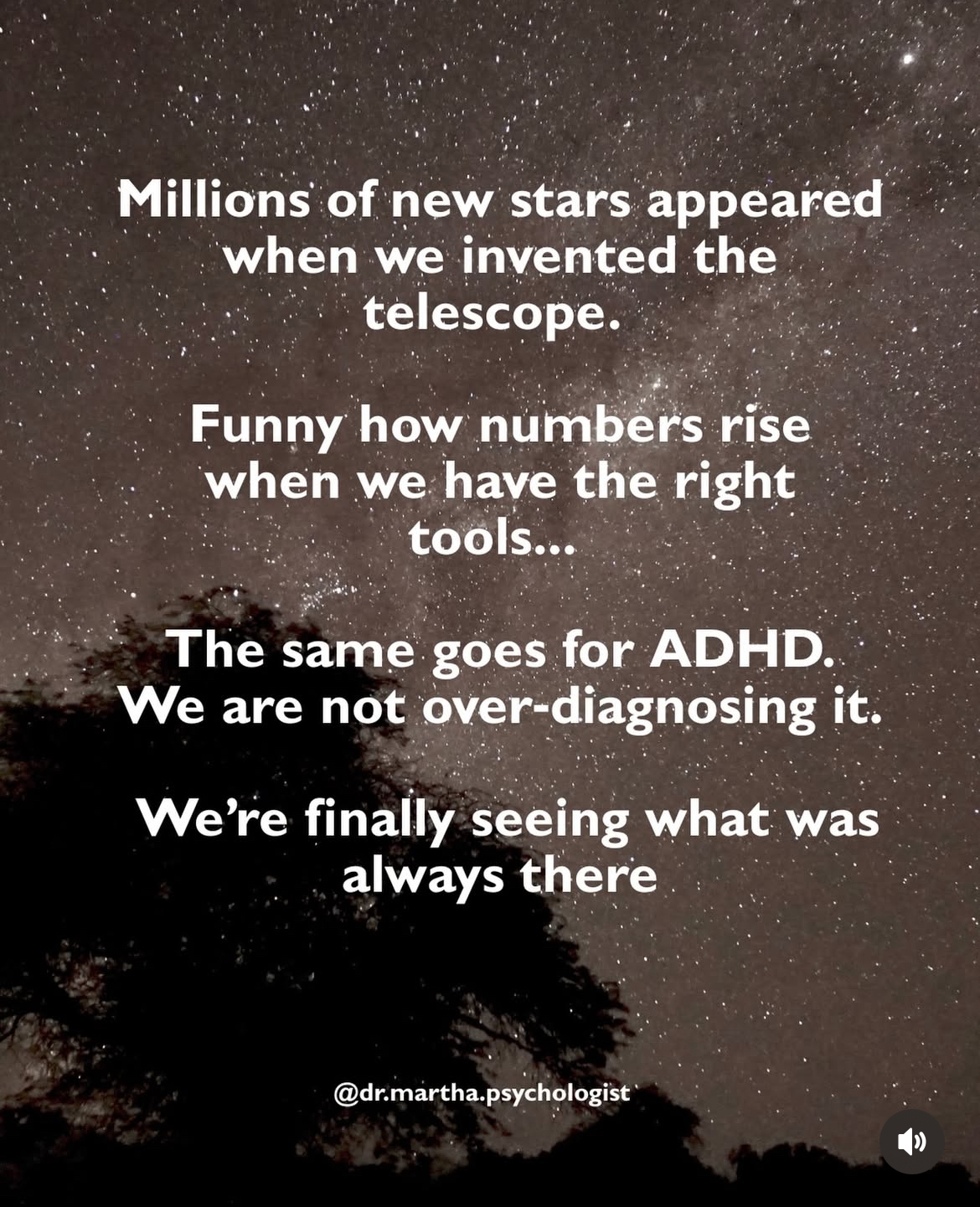
There is a lovely meme on social media at the moment that I have borrowed from Dr Martha Deiros Collado on Instagram (link here) and I think it sums all this up perfectly.
The only other topic I am going to cover today is the debunked link between paracetamol/Tylenol use and autism. The amount of parental guilt when you see your children struggling with life is HUGE. I have spent so many nights wondering what I did wrong. Was it that glass of wine I had before I knew I was pregnant? Was it my stressful job (I found out I was pregnant with our youngest just after an Ofsted inspection)? Was it the fact that all I could eat was salad and chips, and all I could drink was red-bush tea and lemonade? Was it because I worked as an assistant vet nurse, and although I was really careful not to go near anything that may cause any harm to my growing baby, I maybe should have found a different job?

No, no, no, no. Absolutely not. I did not do anything to cause my children’s neurodivergent conditions. Although as parents we have made some decisions that, looking back, could have been better, we did a pretty decent job – and still are. I took paracetamol during pregnancy when I wasn’t well because it was the safest painkiller. I have friends who were on different medications that they needed to take for their own health, and they did nothing wrong either. There have been numerous peer-reviewed studies and meta-analyses that have shown NO link between paracetamol and autism. Paracetamol does not cause autism. We are not in the middle of an epidemic; we are just finally seeing the stars.

The HD Sunflower

I can remember when I first heard about the hidden disabilities Sunflower (if you don’t know about it, find out more here) – we were on holiday in Cornwall, and I read that you could get the lanyards from Morrisons and Sainsburys, so off we went to Newquay to claim our free lanyard. And then it sat in the glove box in my car for months, possibly longer. I changed cars, so the lanyard came into the house, and I told both of our children where it was in case they every needed it.

To be honest I was a little sceptical, and worried on several points. First of all, by wearing a sunflowers, was it almost marking people? Would it lead to them being bullied? Does everyone know about the sunflower and what it means? And would it make any real difference?

On the first point, I was wrong. There is no law saying wearing a sunflower is compulsory, you can take it off until you need it, and the main point of the scheme is that it is for hidden disabilities, so how can people help you if they don’t know you need help? And as you don’t have to wear it, you are unlikely to get bullied. With all the news coming from the US about ‘curing’ autism, though, I am still a little bit worried about what the future may hold, but that doesn’t impact the sunflower scheme.

Secondly, I don’t think everyone does know what the sunflower stands for, but awareness is increasing. And finally, would it make any real difference? YES!

Our eldest son used our one and only lanyard when we went on holiday 18 months ago, and said it made the airport so much easier to navigate, so he kept it and has used it a few times since.

The lightbulb moment for me came 2 weeks ago when we went to Twickenham to watch the Women’s Rugby World Cup final matches. We arrived at Twickenham train station, and it was so much busier than I had expected (there will be another blog to follow about how fantastic the day was and how amazing and emotional it felt to see women’s sport celebrated by so many), and we moved with the crowd down roads that were closed to traffic, and enjoyed the happy atmosphere. As we got closer to the stadium, there was a bit of a bottle neck, with people having to move to the pavements as the road was barriered off. As the crowd got bigger, we all felt uneasy. We noticed that the police and security were letting people in wheelchairs or crutches through, and then we saw someone with a sunflower lanyard going through. My daughter in law had brought the lanyard, but neither of my sons would wear it. As there are 4 out of our party of 5 with hidden disabilities, it seemed ridiculous that they wouldn’t wear it, so I took it, wore it and we all got through the barrier and avoided the slow moving crowd. It was the same going back to the station after the match. We avoided some of the crowds by wearing the lanyard.

In our family of 5 who went to Twickenham, between us there are 3 autistic people, 3 with ADHD, 4 with anxiety, one with OCD and none of these are visible to people watching us. The crowd, going through security, waiting for the train and more are all potential triggers. We all got to enjoy an amazing day out with minimal stress and an avoidance of stress points.

Last week I ordered more lanyards, wrist bands, bracelets and pin badges. If you look on the website, they have a list of hidden or non-visible disabilities (link here), and the list is growing as they want to be as inclusive as possible. I went to London for a meeting on Thursday, and I wore the bracelet. As it happens, there were no triggers, it was a stress free visit, and I didn’t ‘need’ it, but it was a comfort to know it was there, and it actually made a good fidget toy in the meeting.

If you choose to wear the sunflower, you don’t have to wear it all the time, but you can if you want to. You can choose to wear whatever feels most comfortable to you – the ribbon bracelet is the one for me – but you don’t have to wear them if you don’t want to, and I think that’s the joy of the scheme. It’s optional, you can use it as much or a little as you want, but it really can make a difference.

When the nest isn’t empty…..

At this time of year, social media seems to be full of teens going off to university and parents & carers dropping off and then going back to an empty house. As I drove to work this morning, I was moved by a dad’s words about his daughter going to a university 3 hours away next weekend. It’s a very emotional time for them, and for us.

However, it can also be very emotional when your teen’s friends are all going off to university and they aren’t, for whatever reason. It can be very emotional when your friends are all talking about how they are going to fill their evenings now their teens are at uni, and yours is in their bedroom not knowing what they are going to do next. We’ve been there, and it’s tough. We’ve watched friends miss their children as they leave for uni, and then move on to a new era of their lives, while ours seems to carry on as before, but now we have a lost teen who isn’t sure what’s next. If any of you are in this position, you will find a way, and so will they.

Our eldest didn’t go to uni at 18, and took 2 years out. He tried at 20, but it wasn’t for him, and then he went to uni in lockdown and thrived, and now he’s a teacher. I didn’t go to uni til I was 26, and that was the best thing for me at the right time. Had I gone at 18, I wouldn’t have done a course I loved, and I wouldn’t be where I am now.

University isn’t for everyone, either. There are apprenticeships, jobs, training, travel – and there is time to pause and make the right decision.

Not all who go to university live in. Our youngest went to a local uni, and was planning to live in halls and come home regularly, but it quickly became apparent that living away from home wasn’t for him. He commutes from home, he’s saved money and he’s happy – and that’s what matters.

We all develop and grow at different rates. We all have our own path to walk, and we need to let our teens do what’s right for them. It can be hard if we have an empty teen’s room and a quiet house, but it can also be hard if their friends have all moved away and they’re still there. We can feel sad when we have an empty nest, but it can be sad if we feel our young person has been left behind – but they will find their way, and they will be ok, we just need to give them time and listen and sit with them when they want us to.

Echoes

Even though our babies are now adults, we haven’t really felt any empty nests. Our eldest took an extended gap year, then commuted to university, and moved out 5 months before getting married. When he moved out, we were working at the same school, so I still saw him every day, and they live about a mile or two from us, so we see lots of him and his fabulous wife. Our youngest went to university 2 years ago, and although the initial plan had been to spend some time at uni and some time at home, it quickly became apparent that commuting from home would be better for his mental health, as well as his bank balance. Our children may be in their 20s, but there had been no empty nest emotions…..until Cornwall.

We got back from a fabulous 3 generational holiday to Cornwall. We went down with our youngest, our eldest and his wife joined us later on day 1, and then my parents trained down and had a week with us from day 6. We did some things all together, somethings just the two of us, somethings with us splitting into groups and going in different directions. It was a relaxing well needed break.

On the last day, my parents and our eldest and his wife had left early, so it was the three of us for a day of pottering around Padstow until late afternoon when we were going to head back up the M5 to home. We holiday in the seven bays area, and for about 12 years, we holidayed in Harlyn Bay. We stayed in a flat that was a 5 minute walk from the beach, so we would pack a picnic and head down to the bay, spend a few hours beach combing, swimming, surfing and building sandcastles. We had a ‘spot’ that we used to go back to each year, near the top of the beach where we could let wetsuits and swimwear dry on a rocky outcrop. I have so many pictures of sandcastles, slate monoliths and henges that we used to build each year, and I can track the years with the beach tent(s) that we had to take for toddlers napping and for getting changed and hiding from the rain – or seagulls. So many memories on this fantastic little beach. But times change, and flats get sold, and little children grow into bigger children and then adults who want different adventures.

We now stay on the other side of Trevose Head, and we haven’t been on Harlyn beach since 2021. On our last day of this year’s holiday, we went to see what the new pub that has replaced the Harlyn Inn was like. We arrived a little early, so I left them waiting by the pub, and went for a walk on the beach.

I cannot express how emotional it was. It’s not our little beach any more – there are new families now, the age we were when we started holidaying here with little children. No one was in ‘our spot’ but weather and seasons shape the beach, and our spot didn’t look quite like it used to. I retraced the steps we used to take, where slate meets sandstone that can catch your feet when the tide is in. I walked through the sea pools that the tide leaves on its way out. I looked out at the children and teenagers body boarding in the waves, and I saw echoes.

I saw the echoes of us when we had little ones, and when we had bigger ones, and when we had teens that wanted to go into the sea by themselves. I saw us dragging body boards through the shallows. I saw us waiting for the tide to go out so we could go and look at the rock pools.

I hadn’t felt an empty nest until I stood on our beach, in our spot and saw that all we have now is memories – fantastic memories – but our babies are grown up, and seeing and feeling the echoes of the amazing summers we had with them on this little beach in Cornwall moved me far more than I could have imagined.

For those of you reading this with little ones, or bigger ones, or nieces and nephews or grandchildren, breathe it in. Laugh at the sandy foot prints, take photos with your mind, and then, one day, you too can go back and smile at the echoes that are left behind.

Holidays

This isn’t the post I was planning to write today – it was supposed to be a follow up blog about GCSE results that was going to be very similar to my A-level blog last week, but sometimes you just have to go where the words take you, and today, they have taken me to holidays. I am writing this on the Sunday of the Bank Holiday weekend, but I will publish this once we’re on our way home.

Until this year, we have managed to have 2 holidays in the UK each summer – which makes us very lucky. I used to work in Further Education, and the college I worked at broke up for the summer at the end of June/beginning of July. Our children had scholarships to a local private school (again, the fact that we found the money for this even with the help of scholarships makes us very fortunate), so they broke up at the beginning of July. This meant that we could get away for 2 weeks before state schools broke up, when the prices were a little cheaper, especially when we headed to Cornwall. Then, in August, we went away with my parents for a week, usually to Norfolk and we shared the cost, and we also shared the childcare which was a huge thing when our children were younger.

This has continued every year for the last 15+ years, but the teaching job I have now follows school holidays, so because my contract is term time only, we’ve had to stop going away in July. This year, I decided that we would come to Cornwall for 2 weeks – and our second week would be the bank holiday week (I’m sitting writing this in our holiday home). We would come down for 2 weeks, with my parents joining us for the second week, so it was like a hybrid of the holidays we’ve had until this year.

We are having a lovely time – we’ve been to the beaches, but have behaved like locals (I grew up in Poole, Dorset so know how to avoid holiday makers in the summer) and got to the beach early and left when everyone else arrived. We’ve been to our favourite eateries, but have booked tables or got there early to avoid too many crowds, and have been to Newquay and Padstow, but, again, have got there early. It’s been a lovely holiday, and apart from missing the dogs and the cats, I’m in no rush to get home.

However, it is busy. We tried to eat at one of our favourites, and the restaurant was fully booked, even though we had got there late afternoon/early evening, but we could eat at the bar. The first table away from everyone smelt of bins, the second was next to where the band was setting up, and the third was under the speaker with uncomfortable seats. We left and found a plan B that was just as busy, but had outdoor seats. We ordered food (pizzas), had a drink and we left to eat at our holiday home.

This afternoon, our youngest has chatted to me. It’s too busy for him, and he’s also realised that 2 weeks is too long for him. We’ve already booked to come back at Easter, but because he talked to me, we already have a plan. He’s not a child any more, he’s a young adult who is happy catching trains, so at Easter, he will either come with us and train home early, or train down a few days after we arrived and stay til we come home. Problem solved. This holiday, though, he’s stuck with us til we come home on Thursday.

Has this conversation stifled or impacted our holiday? Absolutely not. Has the further revelation before I started writing that he’s spent a lot of time masking this holiday when we’ve been out, so is feeling tired and headachey impacted it? Maybe a little bit, but it’s his holiday too, so I need to be aware of how he’s feeling, and I need to make sure that I do everything I can to help him not to be in too many places where he has to mask. We have talked, and we have a plan.

Looking back, 14 days in a very busy part of Cornwall over the bank holiday weekend wasn’t one of my better ideas, but we live and learn. I’m not perfect, I make decisions that maybe I shouldn’t have done, but I made them with the best intentions. What we can do, is make sure we all have fun on the few days we have left down here. I won’t try and persuade our youngest to come to the beach or go anywhere where he’ll have to mask, and I won’t do that to our eldest either. We may all have to compromise a little bit, but not when it comes to their sensory needs. No compromise there.

We have a day out planned, we know where we’re eating if we’re eating out, and we know that we can all enjoy the next 4 days with minimal masking. I need to breathe, not feel any blame, and know it’s one of those situations that we learn from, and then move on.

For now, I’ve checked the weather so tomorrow is going to be a beach/chill at the house/read kind of day, Tuesday isn’t as good, but we’re off out for the day, and Wednesday will be a quite day with some walks before frantic cleaning and packing as we head back home on Thursday, hoping to avoid the ‘last weekend before the schools go back’ travel chaos on Friday and Saturday.

School report

So, GCSE and A-level results have been & gone. The media (online and print) have made their comments, and not all of those comments have been positive, some of which I wrote about last week (link here).

Successive governments have promised to ‘fix the system’, which is an admirable aim, but successive governments have not done this, and I doubt the white paper on more educational reforms due next month with be full of ideas that will make much of a difference. I will write about this when it comes out, and if I am wrong, I will hold my hands up and admit it.

I strongly believe that the main reason why education isn’t getting better, and for many, including the square pegs, it is getting worse, is for two main reasons. The first is that education is now monetised. The amount of government funds it costs to educate a young person from 5 – 16/18 needs to be repaid in the amount of tax that young person will contribute to society from when they finish their education to when they retire. The second is that the educational reforms are not driven by teachers, students or people in the classroom. They are decided and driven by politicians and civil servants.

I’ll talk about monetisation first. I fully accept that there isn’t a magic money tree, and that governments can’t keep borrowing more and more money. However, I don’t think that each piece of the government purse needs to be looked at individually. Education and the NHS are intrinsically linked. There is a mental health crisis in the UK, especially among under 25s. The waiting lists for CAMHS (Children and Adolescent Mental Health Services) are colossal. In 2022/23, almost one million children were referred to CAMHS, which is 8% of the child population. Of these, over 270,000 were still on the waiting list, and over 370,000 had their referral closed before they could get support – this may be because their parents paid for private support, because they reached 18 and were no longer eligible for CAMHS and would now have to access adult services, because they moved or missed an appointment, or for other reasons. Over 40,000 young people had been waiting for more than 2 years (the source of all of this is available here).

If we improved education so that it didn’t have such a negative impact on many young people’s mental health and well being, if we had more staff trained to spot the early signs of depression, anxiety, OCD, eating disorders etc, and if schools were more ND/Square peg friendly, this would reduce the amount of young people struggling and seeking help from CAMHS. The amount of children home schooled (EHE – elected home educated) or EOTAS (educated other than at school) is also increasing, another sign that the current education system does not meet the needs of all our young people.

We don’t need education reform, we need a complete overhaul of the system. Despite increased testing throughout school (I’ll come onto this in a moment), over 40% of those taking English and maths exams this summer did not get a grade 4 or above (grade 4 is the equivalent of a C grade with the old marking scheme & O-levels). Either the testing is wrong, or the education system is not geared up for 40% of young people taking exams. Now, not everyone is capable of passing 3 maths papers and 2 English papers. Not everyone will get to the grade 4 standard, however we assess them. But something needs to change so that more people are not held back by being part of that 40%. Maths and English passes are needed for so many future opportunities, from achieving a level 3 or higher apprenticeship, to some vocational qualifications (vet nursing and farriery are two), for teacher training, for university and more. I have taught some amazing people who worked in residential children’s homes or care homes. They were fantastic at their jobs, and they were respected within their teams, but because GCSE or Functional Skills exams were difficult for them, they could not achieve their level 3 qualification.

Repeated testing from KS1 (age 5-7) all the way through school to GCSEs and level 3 qualifications will not improve how young people learn. As a biologist, I know that there is no such thing as an average human, and even more so when we look at young people. We do have average milestones, and if a baby or toddler is very late reaching one or more, that can be a cause for concern, but all people learn and develop at different rates. Both of my children, for example, were out of nappies months before their second birthday, but didn’t sleep through the night til they were 3 or more. A friend’s son slept through from about 6 months, but was in nappies til he was almost 3. My children are no better or worse than hers, they just developed differently. Testing little children for how they hold a pencil, how long they can sit still, if they can spell their name, if they can read 10 high frequency words and then keeping these results is, in my opinion, worth very little. Teachers, TAs and nursery nurses do need to keep track and make sure that children are learning, but this can, and should, be learning through play, conversations, games and stories rather than teaching them to hit milestones.

As we move up into KS2, the end goal is SATs that are taken at the end of year 6, just before secondary school. These assess English, maths and science, not how well an 11 year old can hold a conversation, or how well they understand the world around them, or how amazing they are with their hobby. More assessments through KS3, and then formal assessments at 16. More and more testing and teaching to benchmarks obviously isn’t working for over 40% of young people as they are not hitting the benchmarks at 16.

What’s the answer then? Well, I think the first step in education is to start with developing a love of learning, and learning for pleasure and to find out interesting things, rather than being taught how to regurgitate information in a test. We then need to make lessons fun – for the teachers as well as the students – so that inquiry and desire for more information grows. At that point, there is a purpose to writing and reading, and numbers start to matter (how tall was a T-rex, how many goals did Harry Kane score last season, for example). Once there is a purpose to the fundamentals, there will be a motivation to develop them and master them.

If I was to grade the education system in the UK, I would give it a 3 (or a low D). There are some good parts, there are some outstanding classroom staff, but, as a whole, it isn’t hitting benchmarks and must do better.

Don’t believe the hype….

This is the weekend between Level 3 (A-levels, T-levels, BTECs) and Level 2 (GCSE, BTECs) results, and for families who are waiting for both sets, you have my deepest sympathies!

Since Thursday morning, the media (social, online and print) has had stories about how this year’s results compare to previous years, and how many students are about to head off to university. The main headlines have been how the results are up this year, and the number of entries achieving A* or A is up for the second year, as are the top grades for T-level (Technical levels are a relatively new qualification) and other vocational level 3 quals (such as BTECs).

This all makes further education/sixth form education sound great, they’ve all done amazingly well, so congrats to them, and the Department for Education is amazing too as the top grades are up again.

It’s not that simple, and these stories about higher grades and getting university places can make the world seem a little darker if you or a teen you look after didn’t get higher grades, and hasn’t been able to find a place at university. I feel your pain right now. We went through this 10 years ago, and it was tough. The headlines don’t matter if your house can’t share the joy, and although alternatives may be found that actually carve out a better path, it might not feel like that right now. Things will all work out, the sun will shine again, but for now, take time to breathe, and sit with them in the shade until they’re ready to see the sunlight again.

To repeat myself, it’s not as simple as higher grades this year that are building on the higher grades from last year. It’s more complicated than that. In 2020 and 2021, A-level and GCSE grades were not generated by the exam boards:

2020 – teacher grades that then got fed into an algorithm that looked at the school, the area and previous results and came up with grades that were heavily criticised by schools and students.

2021 – centre assessed grades that were more rigorous and subject to scrutiny, and although still not perfect, were better than 2020.

In 2022, students went back to formal exams and assessments, but the marking took into account the previous 2 Covid years, and so results were higher as the marking was kinder.

In 2023, in England (this was not the case in the other nations) assessments went back to pre-Covid marking, and in 2023, A-level grades dropped from the previous 2 Covid years. Purely anecdotal, but my son’s cohort all got at least one grade lower than predicted in each subject.

So, in 2024 in England, the results were higher, and were back to pre-Covid levels in England, which isn’t really a surprise as the GCSE and A-level results were not taken in lockdown years, and this year the results are slightly higher again – but not as high as the press would maybe have you believe from their headlines. In 2023 26.5% of entries achieved A or A*, and in 2025 it was 28.2%. So a rise of less than 2% over 2 years. In Wales the top grades have dropped by 0.4%, and in Northern Ireland, they have increased by 0.1%. Not exactly anything for the press to shout about – but well done to all of those who got these grades, you have plenty to shout about.

Information about the inequality gap has also been a little vague in the press. This year more boys than girls achieved the higher grades (9.8% compared to 9.1%), but boys were also more likely to achieve lower grades (21.2% compared to 18.5% of girls), and I only heard one news article mentioning this.

More worrying for me, are the regional and school gaps. More young people in London, the East and the South Easter got the higher grades compared to the rest of the country, with the North East getting the smallest percentage of higher grades. The school you go to can also impact the grades you have, with students from independent or selective schools more likely to get the higher grades. That doesn’t mean that young people in comprehensives in Sunderland won’t get fantastic grades, it just means that you are more likely to get higher grades if you attend an independent school in London or the South East.

The media pick and choose which bits of information they post, and the same will happen on next Thursday as GCSE results are published. I predict similar regional variations, and similar sensationalising headlines.

At the end of the day, the young people getting their results this August are still part of the Covid generation. Their first years at secondary school were interrupted by lockdown and online learning. They missed out on face to face interactions, and so whatever their results may be, they are all amazing!

All grade information here was taken from https://ffteducationdatalab.org.uk/2025/08/a-level-t-level-and-other-level-3-results-2025-the-main-trends-in-grades-and-entries/

Results day(s)

In England, Wales and Northern Ireland, many 15-18 year olds will be on edge. The last 11+ years have all led to the moment when they open the email or go to school or log onto a portal. In that moment when they look at their results, they will know if they have been a success or a failure in education……..

Except, in the real work, that’s not how it works and that’s not how it ends. Headlines in the press and on social media about A-level and then GCSE results being up or down, about a north/south/east/west divide and how girls or boys have been better or worse this year are there to make us believe that this is it. Whatever those results, they will follow us and haunt us for the rest of our lives – but they won’t.

Education is becoming more and more monetised. A Government document released earlier in July this year is titled ‘Key Stage 2 attainment and lifetime earnings’ (link here) and in it, the levels in KS2 SATs are linked to what that 11 year old may earn in their lifetime. What a load of rubbish, and how awful to have a report that looks at SATs results and how much tax these CHILDREN may pay in their lifetimes. Nothing about happiness, health, mental well being or anything important, just their potential lifetime earnings. There will be similar research out there for GCSE/level 2 results and A-level/level 3 results, and these obviously will include Scottish Nationals and Highers.

Young people’s exam results matter – I am not saying they don’t. What happens over the next year or two will be directly influenced by their results. University, apprenticeships, work, college places may all depend on the numbers of A, B Cs and 9-4s, but life does go on if the required grades don’t appear on the results slip.

What we need to do as we approach results days (and apologies to any readers in Scotland, this is a week too late, I will do better next year) is be there for our young people. I’ll write a more detailed post about what to do if the grades for uni haven’t been met and publish this on Wednesday, but as a general rule, be there for them. Let them feel whatever feelings they are experiencing. Do not berate them or tell them off – what’s done is done. You can’t rewind time, you can’t change the outcome, you can’t shout at the teachers. What you can do, is offer them unconditional love and support, and then, when they’re ready, help them to decide what comes next, be that resits, a different uni course, alternative employment or a year out.

Sometimes getting unexpected results is a good thing. Results that are better than expected can open more doors, and results that are less than expected can open new doors, and both of these can lead to more opportunities. I have personal experience of this (my A-level grades were not what was expected) and also as a parent, and I know it can be tough.

Whatever the results, and whatever way your young people have experienced education (Academy, LEA state school, private school, special school, AP, college, home school, unschool, online school or something else), they’ve done it. At 16 they are through primary and secondary, and they have the freedom to choose school, college, employment or apprenticeships, and at 18 they are done with formal education. Whatever their results day brings, they’ve done it their way, and you should be incredibly proud.

Burn Out

21st century life in the Western World seems to be focused on productivity and results. Via our phones we have access to the internet, social media and emails (work and personal) 24 hours a day. Even though it’s not expected of me at all, I know I check work emails in the evening and at weekends. I also struggle to do nothing, and feel that I have wasted a day if I haven’t ‘done’ anything. I’ve put done in quotation marks as a day resting is still doing something, but my 21st century ADHD brain does not see that as doing something meaningful.

It’s been a busy term at work, and it’s been a busy term at home. The summer term always feels very long, and alongside this there are exam & coursework deadlines, tired learners, tired staff, and we have had the knowledge that Ofsted could visit at any time. I was torn between wanting it this term to get it out of the way, even though we were all tired, as it would be before the new inspection standards arrive in September, and hoping it would be at the end of September when everything was new and fresh.

At home, I have been busy studying. My self-imposed deadline to get all of my doctoral research done and in was the end of the term – and I did it. Huge thanks to any colleagues who are reading this who took part in a focus group discussion during a particularly tiring week, and the lovely young people who agreed to tell me their stories. I am so pleased it’s all in – just analysing and writing for the next 18 months now – and that I hit my deadline.

However, all of this meant that when we finally broke up on Tuesday, I was done. I was burnt out. I was so tired and emotional, and I felt ill. I even did a Covid test as I felt as washed out as I had when I had it. Wednesday I listened to my body – still did an Ikea and Costco trip with my grown up children, and had a uni meeting in the evening, but in between I rested. I resisted the urge to pick up a book and read, and to do some crafting. Instead I flopped on the sofa and watched old episodes of ER. Thursday things got a bit messy again, but I ignored my body and didn’t rest, so Friday was a day of relaxed coffees and reading, and then family time in the evening.

It has taken me over 50 years to learn when I was in burn out. Before I used to get cross with myself for not being able to be my best all the time, for getting over emotional or for wasting a day resting. I hope I have taught my children to do it better, to listen to their bodies, to rest when they need to. We don’t have to do everything every day. A day of rest is a day of doing. Turning off our emails and social media is fine – we can catch up later on or tomorrow. We won’t be able to be our best if we are running on empty, or we are out of spoons.

I have learnt self acceptance this week. I am not invincible, I will, and do, burn out when it gets too much. I am learning to rest when I need to. I hope you will too.