Social Media – the good, the bad & the ugly!

Last week the UK Government announced a social media ban for under 16s that will come into effect next spring. I don’t think anyone would argue that things should carry on as they have been – social media is both a blessing and a curse for all who use it, and the impact it can have on under 16s is scary. This can range from online bullying, harassment, the introduction to all kinds of inappropriate messages (both actual messages, and the subliminal messages from adverts), misogyny, sexism, racism, grooming, and the feeling that they (& also us as adults) are not good enough. I completely agree that something has to change. However, I have several concerns about the ban, and I will discuss these here – but as in my lessons, this is an open discussion so if you feel differently, please comment on the post, email me or post on social media (oh, the irony), and we can have an honest and open conversation. These are just my opinions right now, and I am happy to listen to different opinions and points of view.

  1. What happens when a young person becomes 16? Do they suddenly have access to all of this forbidden land of posts, algorithms and adverts? And why is someone who is 16 and a day suddenly able to manage all the cr4p that’s out there more than someone who is 15 and 360 days? Will there be sessions on how to deal with everything in PSHE and pastoral lessons, because if there aren’t, then I really don’t see how turning 16 suddenly makes someone social media ready.
  2. As this is the Skware Peg blog, I am concerned about the impact that this may have on SEN young people – but there is a bit of a dichotomy here in that the group that is possibly most likely to be bullied online and on social media and who face more difficult challenges may also be the group that will miss out when the ban comes into effect. There is some evidence (& I will find the studies if needed) that young autistic people & those with other SEN are (possibly) more likely to be radicalised via social media, maybe because they have had less face to face interaction, maybe because they are more vulnerable, or maybe because they already feel marginalised. This is dangerous, and puts them, and potentially others, at risk. For the reasons already listed, they also may be more likely to be groomed, or be bullied or harassed online, and their mental health may be impacted by negative experiences. However, for many young people with diagnosed, or undiagnosed, SEN conditions, social media can give them a lifeline to other young people who face similar day to day challenges, or for whom face to face interactions are too much. They will miss out on teenage socialisation and conversations, and it’s not as simple as going out to meet people instead. The alternative may be loneliness. That doesn’t mean we should stop the ban, just be aware of the impact that it may have, and be aware that alternatives are needed.
  3. Teens are tech savvy. According to a poll by the Molly Rose Foundation in April 2026, 61% of Australian teens aged 12-15 still have access to social media (link here), and they also suggested the UK shouldn’t rush to follow. Teens will find a way to access things that are banned, so although this new legislation will protect some young people, there may end up being less protection for the teens who find the loopholes and still access their existing or new accounts. Putting the onus on tech companies is ok, but they have the budget to pay fines, and while prosecutions are ongoing, young people will still find ways to access.
  4. Discussions about this with my 21 year old highlighted that for many children & young adults, social media is a way of keeping up with what is going on in the world, both local, national and international. He has always been interested in politics, so he follows journalists, news organisations and politicians (both who he likes and dislikes) to try and get a balanced view of what’s going on, and to educate himself. He finds news outlets too boring and one sided, so uses social media to get all the sides of a story – and has been since before he was 16.
  5. My eldest son used social media to stay in touch with people who had left his school and moved away. As someone who moved around a little as a child, I would have loved social media as a teen, and would have used it to keep in touch with friends whom I had left behind. As an adult, I found many of them again, but there are too many lost years in between.
  6. Endless scrolling on social media is bad for adults too – we need to find a way to make it healthier for all of us. As a women in her 50s who has a strong interest in politics and education, my algorithms are very different to my husband, also a SEND parent, also with an interest in politics and education. Mine include lots of info about skincare, dieting, botox, weight loss jabs and more. His doesn’t have any of these. We need to fix the algorithms as much as we need to ban social media, and we also need to stop infinite scrolling and go back to the ‘next page’ as it used to be, so that then you’re aware of how much time has been spent stalking friends and watching pimple popper videos….

For me, the proposed social media ban is a sticking plaster on a rather large, ugly wound. It won’t stop tech savvy teens, and as soon as something is banned, it makes it even more attractive. There wasn’t social media when I was a teen, but there were fake IDs, getting people to buy you alcohol or cigarettes, and the fact that we were underage didn’t stop us going out, drinking and/or smoking.

I feel a better solution would be an overhaul of the social media accounts, and making them safer, less addictive and better for all of us, whatever our age. Most of us have an unhealthy relationship with Facebook et al, and banning it for our children doesn’t mean that we will stop posting when we are with them. Writing this short blog has made me reflect about my own social media use. I post pictures and updates to share with people I may not see every day, but I’ve realised that I also post for likes. I use it to follow people I admire, but also to see what people I don’t like quite as much are up to. I use the excuse that I can’t delete the app because I don’t know my password – but that’s just been a lazy excuse. In the evenings I check for updates every half hour or so, even when we’re watching TV. If I use the calculator on my phone, or if I get a message, once I’ve opened my phone, I then check my socials and emails while I’m there, just in case something important has been posted in the last 20 minutes.

Hmm….I am now going to update my passwords, and delete the apps from my phone, so I have to log on via the internet to access them. Maybe, on reflection, the ban isn’t such a bad thing, but maybe it shouldn’t just be for under 16s. I’ll blog again in a couple of weeks to let you know how it’s going (and yes, the irony that I will be sharing this on social media hasn’t escaped me!).
Hello!

Hello! I’m still here, I’ve just been very busy with work, uni and life in general. If I was given £100 for everytime I’ve written ‘but now I’m going to be blogging more regularly’ I would be off on all inclusive holiday, but as the marking gets finished and I have a little more time, I really hope to be blogging more over the summer.

There are so many things that need writing about – the government’s education white paper, the ban on social media for under 16s, proposed changes to GCSEs, the phasing out of BTEC and introduction of V-levels, GCSE and A-level results days, end of the term, transitions, a SEND conference and so much more, so I promise I will try (now I sound like my children when they were younger) to start working on these, but right now, I must return to researching and figuring out my epistemological and ontological stances, and the finish that marking marathon – now in the final straight so I’m hoping to sprint to the finish line!

Even with everything going on, I do read messages and emails, so if there is something that you think I should cover, or if you have a story or situation that needs telling, please contact me on hello@skwarepeg.co.uk

ADHD, Rejection Sensitivity Dysphoria and Me

It’s a year and a day since I got my official ADHD diagnosis, and it’s been a rollercoaster of emotion. I did write about my diagnosis, and how it impacted me, so if you want to have a read, click here. However, one year on, I feel it’s time for more reflections.

Knowing I have ADHD has been good in so many ways. My main reason for getting an official diagnosis was so that I could be kinder to myself, and if I knew I was heading towards burn out, or if I was in a situation that was bad for my mental health, walking away wasn’t quitting, it was doing what I needed to do. I also wanted to be able to rest when I needed to, and not feel that a duvet day was a wasted day. Although that has all happened to a degree, after Christmas I had a lightbulb moment. I also have rejection sensitivity dysphoria (RSD) alongside or part of ADHD. I’ll talk about RSD in a moment, but first of all, spend a couple of minutes in my head…..

I hate to get things wrong or to get a low mark. I hold myself to incredibly high standards, to the point where if I think I will fail at something, I will quit. I used to think this was a character flaw. I don’t think I have ever failed an exam, partly because if I do something, I have to do it well, but also because if I start something that I think I won’t do well, I quit. I have nightmares when I am stressed or under pressure, where I haven’t done ‘something’, so I’ve let someone down, or something bad is going to happen – the thing I haven’t done can vary from dream to dream, and the consequence also varies, but the general premise to these ‘OCD’ dreams is that I have made a mistake, and there will be negative consequences. I often wake up in an anxious state, unsure if the thing I didn’t do was in the dream or in real life, and as I fully awaken, I realise it was in the dream, but that anxiety stays with me. If I text or email someone and they don’t reply, I worry I have said or done something wrong or upset them. If friends make plans without me, I’m not jealous, I’m just convinced I’ve upset or offended one or all of them. I replay conversations in my head all the time, wondering how I could have done things differently – and not just recent conversations. There are conversations I had with my children 10+ years ago that I still think could have been better and more supportive on my part.

When it comes to uni work (both now with my doctorate and looking back with my undergrad and masters), I struggle to let people proof read – in case it’s not good enough. I am now at the stage with my thesis that I need to send work to my supervisors, and the work inevitably comes back with corrections and suggestions, but I am scared to send work to them in case they realise I’m not good enough to be on the course, and tell me I have to leave. In my logical brain, I know I’m good enough, I know that to get better at a doctoral level of writing, I need to be given feedback so that I can improve, but in my ADHD/RSD brain I’m not good enough, I’m winging it, and someone is going to find out.

So, what is RSD? I think I’ve given an outline of how RSD gets into my brain with a fear of rejection and failure, but a quick online search gave me this definition:

Rejection Sensitive Dysphoria (RSD) is a term used to describe extreme emotional sensitivity and reactions to rejection in people with ADHD.” (https://www.simplypsychology.org/rejection-sensitivity-dysphoria-adhd.html) I highly recommend taking a look at the website if you think RSD may apply to you or someone you know.

Many may be reading this and thinking: no one likes to fail, we all get disappointed by rejection, we all worry that our work isn’t good enough’, and I agree. However, RSD goes deeper, and it’s intense. I still sometimes replay conversations from when my children were little, or think about things I did or didn’t do – I didn’t go to see an old lady I looked after before she died, and I worry that I let her down. I didn’t take my grandparents to the Heights of Abraham in Matlock before they died (it was on their wish list), so did I let them down, too? I know I didn’t, but that doesn’t stop me wondering. I often feel that I’m not good enough, or that I could have done better, and, conversely, sometimes I think I’m too much and talked too much in a situation.

Or, at least that’s how it used to be. I didn’t want to talk to people about what was going on in my head, as no one else seemed to feel or think what I was thinking, which fed the RSD and made me feel even more ‘not enough’. And then I had the lightbulb moment. I have taught people with RSD, I have read about RSD, and then I realised that all these thoughts and feelings probably meant that I have RSD too. I’m not broken, I just have an incredibly sensitive brain that likes things to be done well, and I hold myself to a very high standard.

Realising that these feelings are linked to ADHD and RSD has not made them go away, but admitting they are there, and what they are, has allowed me to start to take some control. I know that I need to send work off to my supervisors, so when this blog is finished, I’m going to make a coffee and write – I have set myself the goal of between 500 & 1000 words, but it’s quality over quantity, and even if I ‘only’ write 300, I’m still going to send it across this afternoon.

There are plus sides to RSD, though – it’s not all doom and gloom. Holding myself to high standards means that I do push myself and strive to do better & be better. I am a sensitive and intuitive person – this means that I can often see when others are struggling and can offer help if needed. I also ‘get’ things before others do, and this means I can be a good team player.

Although striving for perfection is tiring, going the extra mile can get results, but I’ve come to realise that it’s all about balance, and that being aware of how RSD can have negative impacts on how I feel. Now I know that the narrative that I’m not enough or that I need to do better is just one possible train of thought, I am starting to change track and rewrite that narrative.

ADHD and RSD often go hand in hand, and out of all my traits, I think RSD is the one that has had the most control. Now I know it’s there, I am taking back control and admitting and facing my fears of failure.

Sometimes it all feels too much

Today was supposed to be a study day – my research for my doctorate is done, so I just (!!) need to spend the next 18 months writing it all up. I had the whole day planned. Quick coffee with my Mum, then home to study. I managed the coffee part ok, but then I came home and doom scrolled about all the horrible things that are going on in the world at the moment. Reading and then writing about education policy seems so trivial when I look at all the things wrong with the world, from all the news coming out of the US to climate change to so many people struggling. Why am I spending time writing about education when I could be researching other things or helping other people?

With classical music blaring through my headphones, I thought about the amazing young people who took part in my research and told me their stories, and I realised that this does matter. It is so important that their stories are told, and that people involved in education and (hopefully) education policy makers read my research when it’s finally done, and that it makes a difference.

My research isn’t about changing the world, it’s about making ripples. If my research touches one person and makes them think and change how they teach – or how they think about teaching – then they make another person’s day a bit better, and so it goes on. The ripples from my research will spread far and wide.

That’s something that I will hold on to as I inevitably doom scroll again later today. In our day to day lives, we cannot change the world, and it’s so tempting, when it all feels too much, to want to hide away, to wonder ‘what’s the point?’. We can make ripples of hope and of community. When I walked the dogs earlier, I passed an older man who was walking slowly trying not to slip in the snow and slush, so I paused, smiled, and said good morning. He looked up, and smiled back, so I smiled at the next person (while trying to keep my dogs under control and stop them jumping up), and they smiled back. My parents walk their dog on a similar route each day, and often stop to chat to the people they pass.

Smiling or saying good morning might not change the day of the person you speak to, but it’s not going to harm them. Holding open a door, letting someone go in front of you, saying thank you to waiting staff – small, seemingly insignificant gestures that just might lift someone.

When it all feels a bit too much, reach out, be kind and show everyone that there is still good in the world.

Where to start….

It’s been 2 months since I last blogged – and there are several reasons for this, but the main one was that I didn’t know where to start. The expected SEND white paper was delayed, the UK government want to introduce more testing, the US government claimed that Tylenol/paracetamol taken in pregnancy could cause autism, the IFS green budget had some very ‘interesting’ opinions on how to solve the SEND crisis, some Reform party members & councillors were criticising the SEND budget (but a local council has also spent £75,000 on union flags to be hung around the county), and then, more recently, there were bits in the autumn budget that makes me very worried about SEND funding, and finally, Wes Streeting, the Health Secretary has started a review into ADHD and ASD because they might be overdiagnosed, which then lead to a BBC GP survey where, apparently, many of them have said that ‘life being stressful is not an illness’ (link here) and that mental health conditions are being over diagnosed. Just when I thought, right, I’ve enough to blog about, something else pops up on my news feed and I then spend several days ranting at anyone who’ll listen, and I don’t actually start blogging.

This is obviously more than one blog, so today I’ll start with ASD, ADHD, diagnosis and causes. I wrote about the genetic roots of ASD & ADHD (link here if you want to read it). While there are some arguments that early life trauma can cause or trigger neurodivergent conditions, this could be an epigenetic trigger, where there is the genetic coding for a condition, but it can also be that trauma almost ‘switches on’ the genes and then the condition is more noticeable. However, sometimes trauma does not switch on genes, but instead, the impact on the body is so great that the external characteristics appear like ASD, ADHD, or PDA, but are a reaction to the trauma. In addition, some conditions, such as MS, can impact cognition in a similar way to dyslexia, but that doesn’t mean that MS causes or triggers dyslexia.

We are not in the middle of a neurodivergent epidemic. I didn’t suddenly catch ADHD in the last few years – the signs have been there since I was tiny, but ADHD was barely recognised in the 1980’s, and even less so in girls, so I was missed. I was also academic, got things done (often at the last minute). Nobody seemed that surprised when my GCSE and then A-level results weren’t near my predicted grades as I was always daydreaming, but if I were a child now, plucking feather duvets, not getting school work done on time, not concentrating in class, being messy, always forgetting where I put things, having a large gap between my reading and spoken language and my written language, the school, or my parents, may have flagged this. I may have had an assessment much, much younger.

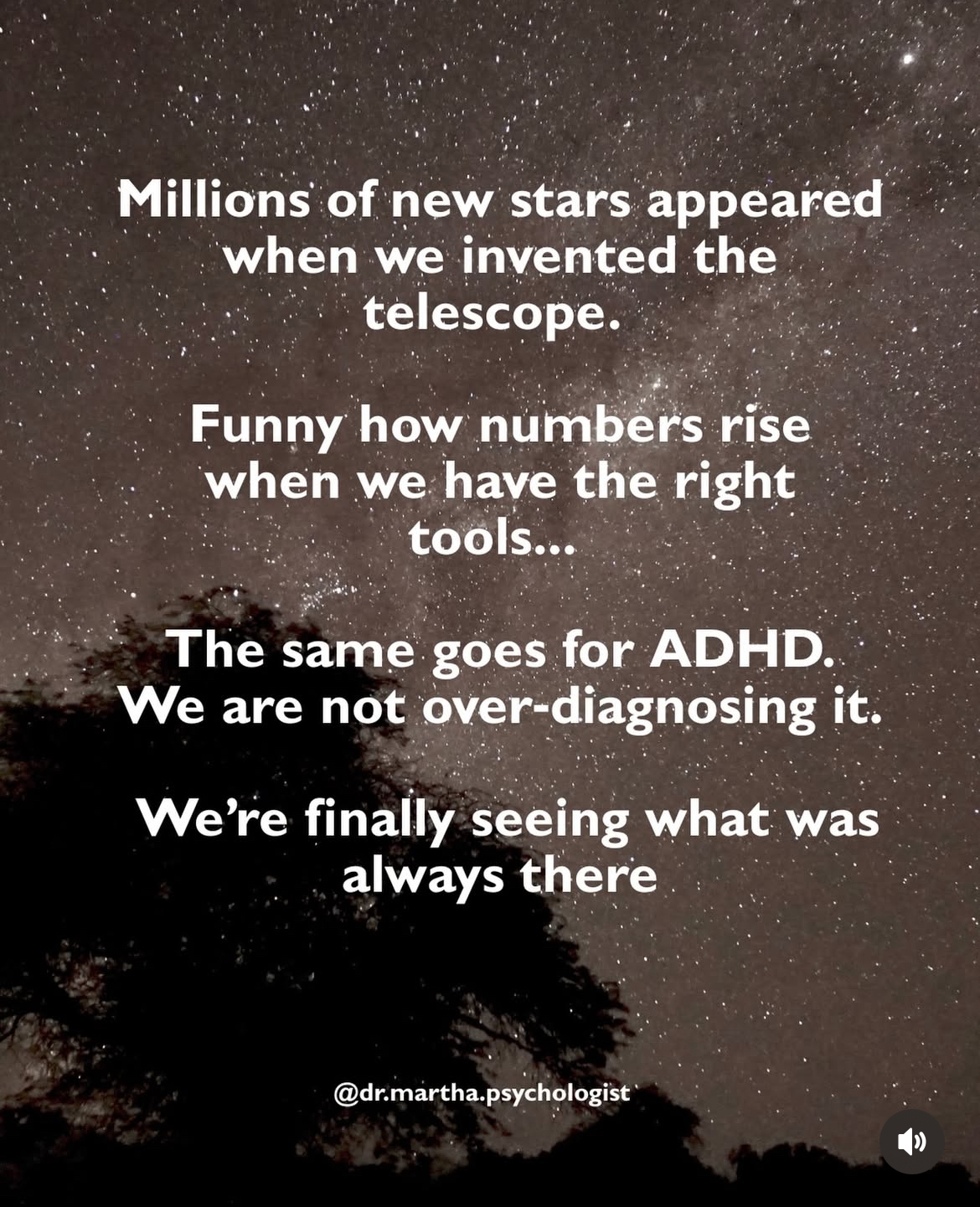
There is a lovely meme on social media at the moment that I have borrowed from Dr Martha Deiros Collado on Instagram (link here) and I think it sums all this up perfectly.

The only other topic I am going to cover today is the debunked link between paracetamol/Tylenol use and autism. The amount of parental guilt when you see your children struggling with life is HUGE. I have spent so many nights wondering what I did wrong. Was it that glass of wine I had before I knew I was pregnant? Was it my stressful job (I found out I was pregnant with our youngest just after an Ofsted inspection)? Was it the fact that all I could eat was salad and chips, and all I could drink was red-bush tea and lemonade? Was it because I worked as an assistant vet nurse, and although I was really careful not to go near anything that may cause any harm to my growing baby, I maybe should have found a different job?

No, no, no, no. Absolutely not. I did not do anything to cause my children’s neurodivergent conditions. Although as parents we have made some decisions that, looking back, could have been better, we did a pretty decent job – and still are. I took paracetamol during pregnancy when I wasn’t well because it was the safest painkiller. I have friends who were on different medications that they needed to take for their own health, and they did nothing wrong either. There have been numerous peer-reviewed studies and meta-analyses that have shown NO link between paracetamol and autism. Paracetamol does not cause autism. We are not in the middle of an epidemic; we are just finally seeing the stars.

The HD Sunflower

I can remember when I first heard about the hidden disabilities Sunflower (if you don’t know about it, find out more here) – we were on holiday in Cornwall, and I read that you could get the lanyards from Morrisons and Sainsburys, so off we went to Newquay to claim our free lanyard. And then it sat in the glove box in my car for months, possibly longer. I changed cars, so the lanyard came into the house, and I told both of our children where it was in case they every needed it.

To be honest I was a little sceptical, and worried on several points. First of all, by wearing a sunflowers, was it almost marking people? Would it lead to them being bullied? Does everyone know about the sunflower and what it means? And would it make any real difference?

On the first point, I was wrong. There is no law saying wearing a sunflower is compulsory, you can take it off until you need it, and the main point of the scheme is that it is for hidden disabilities, so how can people help you if they don’t know you need help? And as you don’t have to wear it, you are unlikely to get bullied. With all the news coming from the US about ‘curing’ autism, though, I am still a little bit worried about what the future may hold, but that doesn’t impact the sunflower scheme.

Secondly, I don’t think everyone does know what the sunflower stands for, but awareness is increasing. And finally, would it make any real difference? YES!

Our eldest son used our one and only lanyard when we went on holiday 18 months ago, and said it made the airport so much easier to navigate, so he kept it and has used it a few times since.

The lightbulb moment for me came 2 weeks ago when we went to Twickenham to watch the Women’s Rugby World Cup final matches. We arrived at Twickenham train station, and it was so much busier than I had expected (there will be another blog to follow about how fantastic the day was and how amazing and emotional it felt to see women’s sport celebrated by so many), and we moved with the crowd down roads that were closed to traffic, and enjoyed the happy atmosphere. As we got closer to the stadium, there was a bit of a bottle neck, with people having to move to the pavements as the road was barriered off. As the crowd got bigger, we all felt uneasy. We noticed that the police and security were letting people in wheelchairs or crutches through, and then we saw someone with a sunflower lanyard going through. My daughter in law had brought the lanyard, but neither of my sons would wear it. As there are 4 out of our party of 5 with hidden disabilities, it seemed ridiculous that they wouldn’t wear it, so I took it, wore it and we all got through the barrier and avoided the slow moving crowd. It was the same going back to the station after the match. We avoided some of the crowds by wearing the lanyard.

In our family of 5 who went to Twickenham, between us there are 3 autistic people, 3 with ADHD, 4 with anxiety, one with OCD and none of these are visible to people watching us. The crowd, going through security, waiting for the train and more are all potential triggers. We all got to enjoy an amazing day out with minimal stress and an avoidance of stress points.

Last week I ordered more lanyards, wrist bands, bracelets and pin badges. If you look on the website, they have a list of hidden or non-visible disabilities (link here), and the list is growing as they want to be as inclusive as possible. I went to London for a meeting on Thursday, and I wore the bracelet. As it happens, there were no triggers, it was a stress free visit, and I didn’t ‘need’ it, but it was a comfort to know it was there, and it actually made a good fidget toy in the meeting.

If you choose to wear the sunflower, you don’t have to wear it all the time, but you can if you want to. You can choose to wear whatever feels most comfortable to you – the ribbon bracelet is the one for me – but you don’t have to wear them if you don’t want to, and I think that’s the joy of the scheme. It’s optional, you can use it as much or a little as you want, but it really can make a difference.

When the nest isn’t empty…..

At this time of year, social media seems to be full of teens going off to university and parents & carers dropping off and then going back to an empty house. As I drove to work this morning, I was moved by a dad’s words about his daughter going to a university 3 hours away next weekend. It’s a very emotional time for them, and for us.

However, it can also be very emotional when your teen’s friends are all going off to university and they aren’t, for whatever reason. It can be very emotional when your friends are all talking about how they are going to fill their evenings now their teens are at uni, and yours is in their bedroom not knowing what they are going to do next. We’ve been there, and it’s tough. We’ve watched friends miss their children as they leave for uni, and then move on to a new era of their lives, while ours seems to carry on as before, but now we have a lost teen who isn’t sure what’s next. If any of you are in this position, you will find a way, and so will they.

Our eldest didn’t go to uni at 18, and took 2 years out. He tried at 20, but it wasn’t for him, and then he went to uni in lockdown and thrived, and now he’s a teacher. I didn’t go to uni til I was 26, and that was the best thing for me at the right time. Had I gone at 18, I wouldn’t have done a course I loved, and I wouldn’t be where I am now.

University isn’t for everyone, either. There are apprenticeships, jobs, training, travel – and there is time to pause and make the right decision.

Not all who go to university live in. Our youngest went to a local uni, and was planning to live in halls and come home regularly, but it quickly became apparent that living away from home wasn’t for him. He commutes from home, he’s saved money and he’s happy – and that’s what matters.

We all develop and grow at different rates. We all have our own path to walk, and we need to let our teens do what’s right for them. It can be hard if we have an empty teen’s room and a quiet house, but it can also be hard if their friends have all moved away and they’re still there. We can feel sad when we have an empty nest, but it can be sad if we feel our young person has been left behind – but they will find their way, and they will be ok, we just need to give them time and listen and sit with them when they want us to.

Echoes

Even though our babies are now adults, we haven’t really felt any empty nests. Our eldest took an extended gap year, then commuted to university, and moved out 5 months before getting married. When he moved out, we were working at the same school, so I still saw him every day, and they live about a mile or two from us, so we see lots of him and his fabulous wife. Our youngest went to university 2 years ago, and although the initial plan had been to spend some time at uni and some time at home, it quickly became apparent that commuting from home would be better for his mental health, as well as his bank balance. Our children may be in their 20s, but there had been no empty nest emotions…..until Cornwall.

We got back from a fabulous 3 generational holiday to Cornwall. We went down with our youngest, our eldest and his wife joined us later on day 1, and then my parents trained down and had a week with us from day 6. We did some things all together, somethings just the two of us, somethings with us splitting into groups and going in different directions. It was a relaxing well needed break.

On the last day, my parents and our eldest and his wife had left early, so it was the three of us for a day of pottering around Padstow until late afternoon when we were going to head back up the M5 to home. We holiday in the seven bays area, and for about 12 years, we holidayed in Harlyn Bay. We stayed in a flat that was a 5 minute walk from the beach, so we would pack a picnic and head down to the bay, spend a few hours beach combing, swimming, surfing and building sandcastles. We had a ‘spot’ that we used to go back to each year, near the top of the beach where we could let wetsuits and swimwear dry on a rocky outcrop. I have so many pictures of sandcastles, slate monoliths and henges that we used to build each year, and I can track the years with the beach tent(s) that we had to take for toddlers napping and for getting changed and hiding from the rain – or seagulls. So many memories on this fantastic little beach. But times change, and flats get sold, and little children grow into bigger children and then adults who want different adventures.

We now stay on the other side of Trevose Head, and we haven’t been on Harlyn beach since 2021. On our last day of this year’s holiday, we went to see what the new pub that has replaced the Harlyn Inn was like. We arrived a little early, so I left them waiting by the pub, and went for a walk on the beach.

I cannot express how emotional it was. It’s not our little beach any more – there are new families now, the age we were when we started holidaying here with little children. No one was in ‘our spot’ but weather and seasons shape the beach, and our spot didn’t look quite like it used to. I retraced the steps we used to take, where slate meets sandstone that can catch your feet when the tide is in. I walked through the sea pools that the tide leaves on its way out. I looked out at the children and teenagers body boarding in the waves, and I saw echoes.

I saw the echoes of us when we had little ones, and when we had bigger ones, and when we had teens that wanted to go into the sea by themselves. I saw us dragging body boards through the shallows. I saw us waiting for the tide to go out so we could go and look at the rock pools.

I hadn’t felt an empty nest until I stood on our beach, in our spot and saw that all we have now is memories – fantastic memories – but our babies are grown up, and seeing and feeling the echoes of the amazing summers we had with them on this little beach in Cornwall moved me far more than I could have imagined.

For those of you reading this with little ones, or bigger ones, or nieces and nephews or grandchildren, breathe it in. Laugh at the sandy foot prints, take photos with your mind, and then, one day, you too can go back and smile at the echoes that are left behind.

Holidays

This isn’t the post I was planning to write today – it was supposed to be a follow up blog about GCSE results that was going to be very similar to my A-level blog last week, but sometimes you just have to go where the words take you, and today, they have taken me to holidays. I am writing this on the Sunday of the Bank Holiday weekend, but I will publish this once we’re on our way home.

Until this year, we have managed to have 2 holidays in the UK each summer – which makes us very lucky. I used to work in Further Education, and the college I worked at broke up for the summer at the end of June/beginning of July. Our children had scholarships to a local private school (again, the fact that we found the money for this even with the help of scholarships makes us very fortunate), so they broke up at the beginning of July. This meant that we could get away for 2 weeks before state schools broke up, when the prices were a little cheaper, especially when we headed to Cornwall. Then, in August, we went away with my parents for a week, usually to Norfolk and we shared the cost, and we also shared the childcare which was a huge thing when our children were younger.

This has continued every year for the last 15+ years, but the teaching job I have now follows school holidays, so because my contract is term time only, we’ve had to stop going away in July. This year, I decided that we would come to Cornwall for 2 weeks – and our second week would be the bank holiday week (I’m sitting writing this in our holiday home). We would come down for 2 weeks, with my parents joining us for the second week, so it was like a hybrid of the holidays we’ve had until this year.

We are having a lovely time – we’ve been to the beaches, but have behaved like locals (I grew up in Poole, Dorset so know how to avoid holiday makers in the summer) and got to the beach early and left when everyone else arrived. We’ve been to our favourite eateries, but have booked tables or got there early to avoid too many crowds, and have been to Newquay and Padstow, but, again, have got there early. It’s been a lovely holiday, and apart from missing the dogs and the cats, I’m in no rush to get home.

However, it is busy. We tried to eat at one of our favourites, and the restaurant was fully booked, even though we had got there late afternoon/early evening, but we could eat at the bar. The first table away from everyone smelt of bins, the second was next to where the band was setting up, and the third was under the speaker with uncomfortable seats. We left and found a plan B that was just as busy, but had outdoor seats. We ordered food (pizzas), had a drink and we left to eat at our holiday home.

This afternoon, our youngest has chatted to me. It’s too busy for him, and he’s also realised that 2 weeks is too long for him. We’ve already booked to come back at Easter, but because he talked to me, we already have a plan. He’s not a child any more, he’s a young adult who is happy catching trains, so at Easter, he will either come with us and train home early, or train down a few days after we arrived and stay til we come home. Problem solved. This holiday, though, he’s stuck with us til we come home on Thursday.

Has this conversation stifled or impacted our holiday? Absolutely not. Has the further revelation before I started writing that he’s spent a lot of time masking this holiday when we’ve been out, so is feeling tired and headachey impacted it? Maybe a little bit, but it’s his holiday too, so I need to be aware of how he’s feeling, and I need to make sure that I do everything I can to help him not to be in too many places where he has to mask. We have talked, and we have a plan.

Looking back, 14 days in a very busy part of Cornwall over the bank holiday weekend wasn’t one of my better ideas, but we live and learn. I’m not perfect, I make decisions that maybe I shouldn’t have done, but I made them with the best intentions. What we can do, is make sure we all have fun on the few days we have left down here. I won’t try and persuade our youngest to come to the beach or go anywhere where he’ll have to mask, and I won’t do that to our eldest either. We may all have to compromise a little bit, but not when it comes to their sensory needs. No compromise there.

We have a day out planned, we know where we’re eating if we’re eating out, and we know that we can all enjoy the next 4 days with minimal masking. I need to breathe, not feel any blame, and know it’s one of those situations that we learn from, and then move on.

For now, I’ve checked the weather so tomorrow is going to be a beach/chill at the house/read kind of day, Tuesday isn’t as good, but we’re off out for the day, and Wednesday will be a quite day with some walks before frantic cleaning and packing as we head back home on Thursday, hoping to avoid the ‘last weekend before the schools go back’ travel chaos on Friday and Saturday.